Reading Group Rides: Never Get Caught Off Guard Again
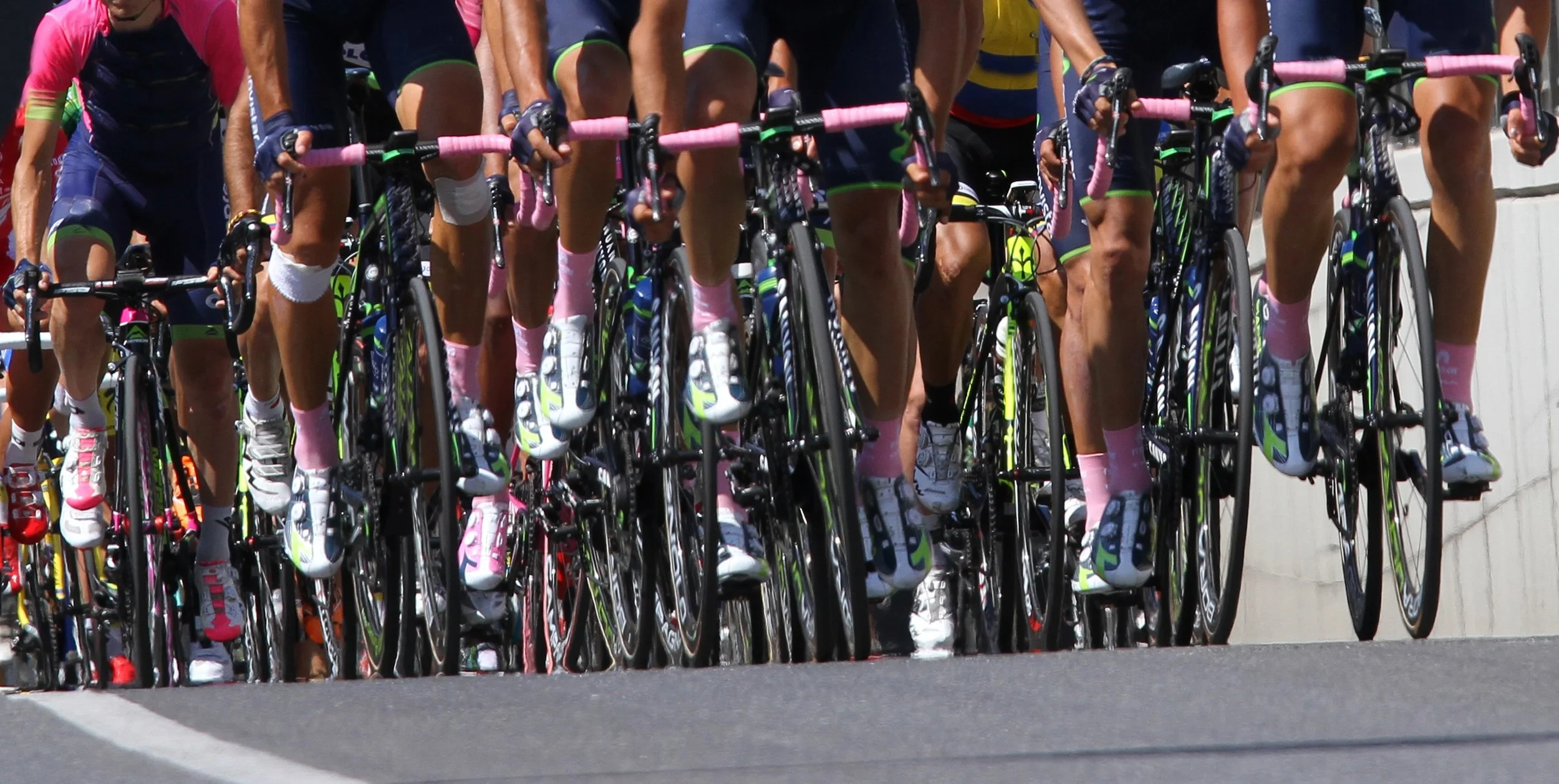
You've been dropped before.
Not because you weren't fit enough. But because you didn't see it coming. A pace surge on a climb, a gap that opened while you were looking the wrong way, a positioning mistake that left you on the wrong side of a split. By the time you realised what was happening, the damage was done.
Group riding is a skill. And like every skill, it's coachable — once you understand what you're actually looking at.
Why Group Riding Is Its Own Discipline
The physics of riding in a bunch are well established. Drafting in a group reduces the aerodynamic drag experienced by following riders by 20–40% depending on position and proximity [1]. In large pelotons, riders in the mid to rear positions can experience drag reductions of up to 95% compared to riding solo [2].
That energy saving is the foundation of all group riding tactics. It's why groups ride faster than individuals. It's why position matters. And it's why the difference between riding efficiently in a group and riding inefficiently in the same group can be the equivalent of several watts of sustained power — the exact margin that determines whether you're comfortable or suffering.
But the physics are the easy part. What most cyclists miss is the behavioural layer on top of them — the signals, patterns, and moments of decision that determine how a group ride actually unfolds.
The Signals Most Riders Miss
Group rides communicate constantly. The problem is that most riders are only paying attention to the wheel directly in front of them.
Changes at the front. The pace of a group ride is set at the front. When the riders pulling at the front begin to shorten their turns, increase their cadence, or show signs of fatigue, a pace change is usually imminent. Reading what's happening two or three riders ahead — not just the wheel immediately in front — gives you time to prepare rather than react.
The approach to climbs. Groups accelerate before climbs, not during them. The surge typically begins 100–200 metres before the gradient starts, as stronger riders position themselves to control the pace over the top. If you're not aware of this pattern, you'll be in the wrong gear, in the wrong position, and already at threshold before the climb has even started.
Accordion effect. Groups compress and expand constantly. At the back of a bunch, small pace variations at the front are amplified significantly by the time they reach the rear. Riders at the back work harder, accelerate more sharply, and spend more time in and out of the draft than those at the front and middle. Understanding where you sit in the group — and the mechanical consequences of that position — is tactical knowledge that directly affects how hard you work.
Position As Energy Management
Research on competitive cycling confirms that tactical positioning within a group is one of the primary determinants of performance in bunch riding events [3]. The riders who manage their energy best across a long group ride are rarely the fittest riders in the group. They're the most positionally intelligent ones.
Moving up through a group costs energy. Dropping back costs position. The riders who understand how to maintain their preferred position without repeated surges and recoveries are the ones who arrive at the business end of a ride with something left — while others are already emptied out.
This is an observable skill in any group ride. Watch who is constantly drifting and chasing. Watch who holds their position with minimal visible effort. The difference is rarely fitness. It's awareness and anticipation.
Why Masters Cyclists Benefit Most From Getting This Right
For riders over 40, positional intelligence in a group isn't just a nice tactical refinement. It's a genuine performance multiplier.
After 40, the ability to respond to repeated surges and recover quickly between them diminishes relative to younger riders. The cost of being caught out of position — of having to chase, accelerate sharply, or spend extended time at the back of the bunch — compounds more significantly with age.
The masters cyclists who stay competitive in group rides well into their 50s are rarely the strongest in absolute terms. They're the ones who work the least to stay where they need to be. They read the group before it moves, position themselves before the surge, and rarely need to chase because they were never in a position where chasing was necessary.
That anticipation — reading five seconds ahead rather than reacting to what just happened — is the skill that separates them. And it is entirely learnable.
Frequently Asked Questions
Is group riding skill something you develop automatically from riding in groups?
Partially — but unconscious repetition reinforces habits as easily as it builds skills. Riders who have spent years at the back of a bunch, reacting and chasing, often develop deeply ingrained inefficiencies. Deliberate attention to what's happening in the group — not just surviving it — is what accelerates the development of genuine tactical awareness.
How does crosswind riding change group dynamics?
Significantly. In crosswinds, the draft line shifts diagonally, and groups naturally form echelons — diagonal formations that maximise protection from the wind. Riders who don't understand this end up in exposed positions that offer little drafting benefit. Reading the wind direction and anticipating echelon formation is a specific skill within group riding.
Is front-of-group riding always better than the middle?
Not always. The front involves more work and greater exposure to wind. The optimal position depends on the purpose of the ride, the terrain ahead, and what's happening in the group at any given moment. Positional intelligence means knowing where to be for each section of the ride — not defaulting to the same position throughout.
Why do I keep getting dropped at the same point on every ride?
Repeated drops at the same location are diagnostic. They usually point to a pacing error in the section before that point, a positional mistake that leaves you exposed when the pace changes, or a specific fitness limitation being exposed by the demands of that terrain. Identifying which of these is causing the problem is the first step to solving it.
References
1. Blocken, B., Defraeye, T., Toparlar, Y., & Andrianne, T. (2018). Aerodynamic drag in cycling pelotons: New insights by CFD simulation and wind tunnel testing. Journal of Wind Engineering and Industrial Aerodynamics, 179, 319–337. https://doi.org/10.1016/j.jweia.2018.06.011
2. Íñiguez-de-la-Torre, A., & Íñiguez, J. (2009). Aerodynamics of a cycling peloton. European Journal of Physics, 30(1), 189. https://doi.org/10.1088/0143-0807/30/1/017
3. Menaspà, P., Quod, M., Martin, D. T., Peiffer, J. J., & Abbiss, C. R. (2015). Physical demands of sprint cycling in high-level road cycling races. International Journal of Sports Physiology and Performance, 10(7), 840–844. https://doi.org/10.1123/ijspp.2014-0554