3 Mobility Limitations That Quietly Steal Your Cycling Power After 40
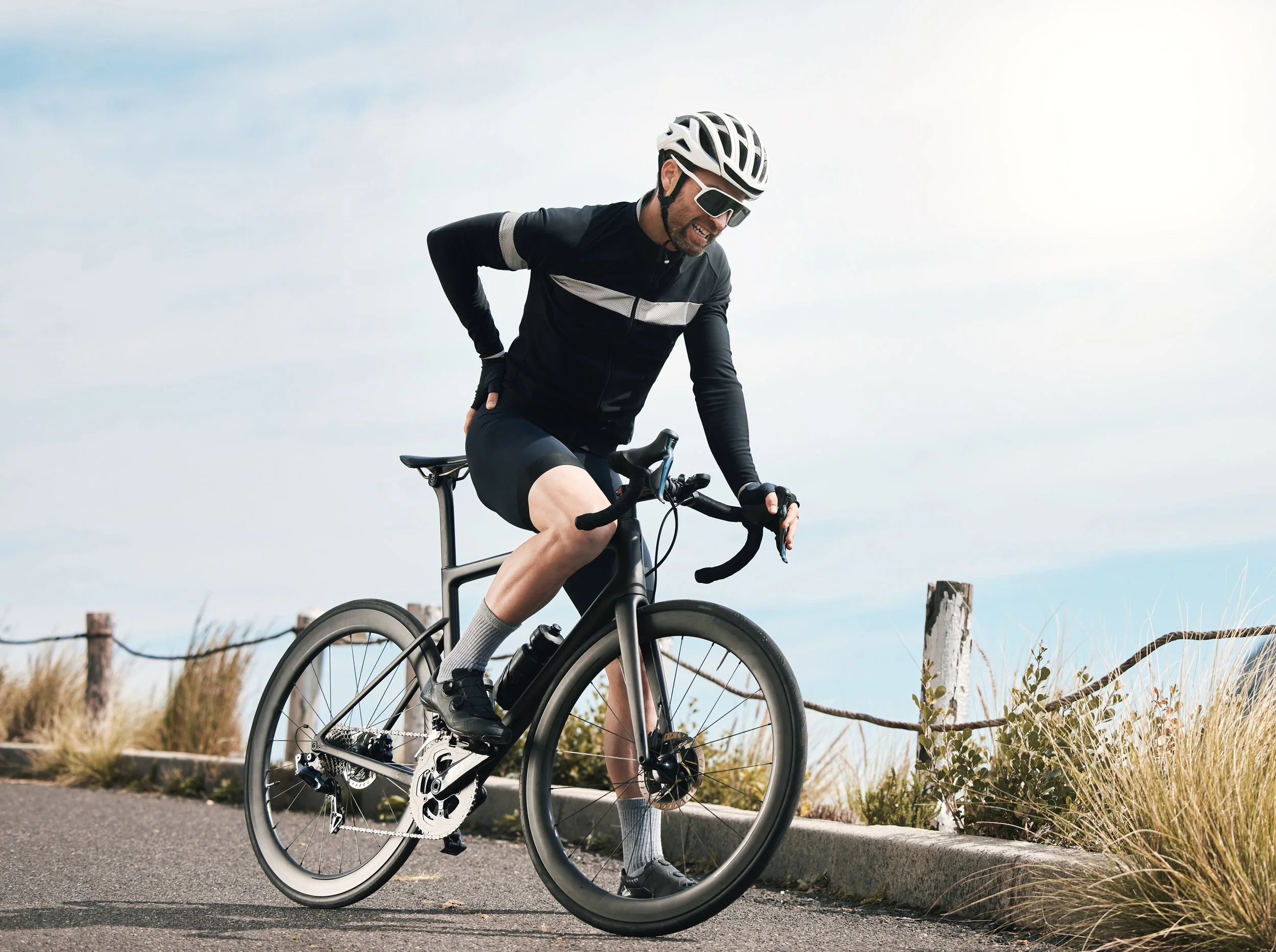
You've worked on your fitness. You've done the intervals. You've put in the hours.
But something still feels off on the bike. Your position feels uncomfortable after an hour. Your lower back aches on longer rides. And somehow, despite the training, your power on climbs isn't translating the way it should.
The problem often isn't your engine. It's your chassis.
Specific mobility restrictions — ones that develop and worsen over decades of desk work, driving, and sedentary patterns — directly limit the power you can generate on the bike. Here's what they are, why they matter, and what to do about them.
Mobility vs. Flexibility: Why the Distinction Matters
These terms are often used interchangeably, but they're different.
Flexibility is passive — how far a muscle can be stretched when an external force is applied. Mobility is active — your ability to move a joint through its full range under your own muscular control.
For cyclists, mobility is what matters. You need active control of your hip position, spinal alignment, and pedal stroke mechanics — not just the ability to stretch into a position passively. This distinction also explains why static stretching alone rarely fixes performance issues on the bike.
Limitation 1: Restricted Hip Flexors
Tight hip flexors are almost universal in cyclists over 40. Hours on the bike — combined with prolonged sitting at a desk — keep the hip in a chronically shortened flexed position. Over time, the hip flexors adaptively shorten.
On the bike, this restriction matters enormously.
Research confirms that hip mobility directly influences pedalling mechanics, power output, and lower back loading in cyclists (McEvoy et al., 2020). When the hip flexors are restricted, the pelvis tips into a posterior tilt — flattening the lumbar curve, reducing glute activation, and forcing the lower back to compensate.
The result: wasted power, back pain, and a pedal stroke that works against you on every climb.
The fix: The kneeling hip flexor stretch — a 90-second hold per side, daily — combined with strength work targeting the glutes and hip extensors. Stretching alone isn't enough. Tight hip flexors are often weak hip flexors. Strengthening them through their full range restores both mobility and power.
Limitation 2: Reduced Thoracic Spine Mobility
The thoracic spine — the middle section of your back — is designed to rotate and extend. After 40, and particularly in cyclists who spend long hours in a forward-flexed riding position, thoracic mobility progressively reduces.
This matters for two reasons.
First, a stiff thoracic spine forces the lumbar spine (your lower back) to compensate — absorbing movement it wasn't designed to handle. This is one of the primary drivers of lower back pain in cyclists and a finding supported by systematic review evidence (Harvey et al., 2020).
Second, reduced thoracic rotation limits your ability to breathe deeply on the bike. Your ribcage attaches to your thoracic vertebrae. When thoracic rotation is restricted, rib expansion is limited — and so is your breathing capacity at maximal effort.
The fix: Thoracic rotation mobility drills performed daily. A simple and effective option: seated rotation in a chair or on the bike, turning slowly through your upper back while keeping your hips still. Foam roller thoracic extension is also highly effective and takes less than five minutes.
Limitation 3: Hamstring Tightness and Pelvic Tilt
Hamstring flexibility has a direct, measurable relationship with cycling performance.
A study of 50 well-trained male cyclists found that hamstring flexibility significantly correlated with handlebar drop, saddle setback, and peak power output (McEvoy et al., 2020). Cyclists with greater hamstring flexibility could adopt a more anteriorly tilted pelvis — a position that increases force production during the push phase of the pedal stroke and improves aerodynamic position.
When hamstrings are tight, the pelvis tilts posteriorly. This changes the angle at the hip, reduces glute recruitment, and limits how efficiently you can transfer power through each pedal revolution.
It's one of the most common findings in a clinical cycling assessment — and one of the most directly correctable.
The fix: Progressive hamstring loading through full range. Exercises like Romanian deadlifts and single-leg Romanian deadlifts are more effective than static stretching because they build strength and length simultaneously — addressing both the tightness and the underlying weakness.
How Much Time Does This Actually Take?
The mobility work that addresses all three of these limitations requires 10–15 minutes per day. That's it.
It doesn't need to be a separate session. It can be done after a ride, while watching television, or as part of your morning routine.
The physio-informed principle here is consistency over intensity. Ten minutes every day produces far better outcomes than an hour once a week. Tissue adaptation — the gradual lengthening and remodelling of restricted structures — requires repeated, low-load stimulus over time.
The riders who make the most progress are the ones who treat mobility work as part of their training, not an afterthought. Because on the bike, your power is only as good as your body's ability to access it.
Frequently Asked Questions
Should I stretch before or after a ride?
Dynamic mobility work — controlled movement through range — is well-suited before a ride to prepare joints and activate muscles. Static holds and deeper flexibility work are better placed after a ride when tissues are warm and pliable.
How long before I notice a difference on the bike?
Most riders notice a meaningful improvement in comfort and pedal stroke feel within three to four weeks of consistent daily mobility work. Performance benefits — improved power transfer and reduced back fatigue — typically follow.
Does yoga count?
Yes — particularly for thoracic mobility and hip flexibility. Yoga styles that emphasise controlled movement and held poses (such as Hatha or Yin yoga) are highly complementary to cycling-specific mobility work.
Is this relevant if I don't have any pain?
Absolutely. Mobility restrictions reduce performance well before they cause pain. Many riders discover through a bike fit or physio assessment that restrictions they weren't aware of were limiting their power output and efficiency.
References
Harvey, N. R., Holt, S. M., Lee, I., Livingston, L., & Rankin, A. (2020). Clinical reasoning framework for thoracic spine exercise prescription in sport: A systematic review and narrative synthesis. BMJ Open Sport & Exercise Medicine, 6(1), e000741. https://doi.org/10.1136/bmjsem-2020-000741
McEvoy, M., Wadsworth, D., & Adams, R. (2020). Performance variables associated with bicycle configuration and flexibility. Journal of Science and Medicine in Sport, 24(3), 247–252. https://doi.org/10.1016/j.jsams.2020.09.009
Wadsworth, D., & Weinrauch, P. (2019). The role of a bike fit in cyclists with hip pain: A clinical commentary. International Journal of Sports Physical Therapy, 14(3), 468–486. https://pmc.ncbi.nlm.nih.gov/articles/PMC6818133/