A 5-Minute Pre-Climb Warm-Up Can Change How A “Hard” Climb Feels.
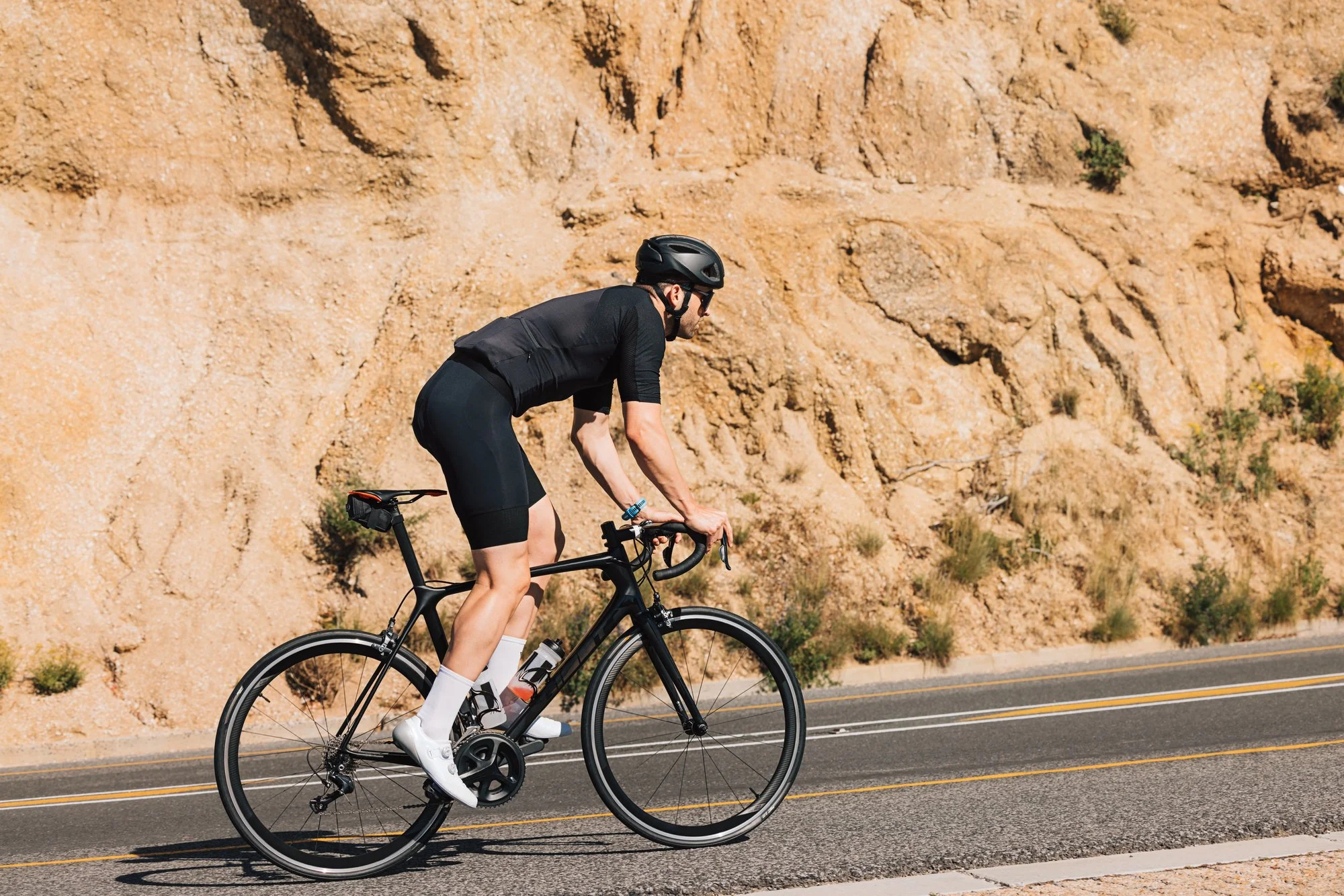
You're cruising along at a manageable (aerobic) pace with the group. Legs feel fine, breathing and conversation is easy and it feels like you’re having an “on day”.
Then the road tips up and the group pace lifts.
Within 60 to 90 seconds, your breathing is laboured, your legs are on fire and you're slipping off the back or hanging on for dear life and wondering how the rest of the group is cruising up like it's nothing.
Many cyclists put this down to fitness. And sometimes it is. But often, it's not.
It's that your body wasn't primed for that sudden change from steady spinning to a hard climbing effort. Even if the climb is well within your capability.
Why The First Minute Of A Climb Hits So Hard
At the start of any hard effort, your body has to (pardon the pun) ‘shift gears’. Your aerobic system doesn't respond instantly. Even if it is fully capable with the coming effort, it still takes 30 to 60+ seconds to ramp up oxygen delivery to the working muscles [1], even
In the meantime, your anaerobic system has to kick in to cover for this lag. That means lactate production, hydrogen ion accumulation and rapidly rising perceived exertion. All the sensations that make the first minute of a climb feel disproportionately awful.
But, if you ‘prime up’ the muscles before a hard effort, this speeds up your “VO2 kinetics” [2, 3]. With priming, your body can reach a new higher aerobic operating point (that needed for the climb) faster and with less oxygen deficit, less lactate and less of the sudden terrible feeling in that first minute.
Priming also improves muscle temperature. A warm muscle contracts more efficiently, uses oxygen better and produces less metabolic waste per unit of power [4].
This Becomes More Relevant As You Age.
All the above happens at any age, but it is even more important for those of us cyclists over 40.
Why, because VO2 kinetics slows with age [5]. The ramp up time needed from spinning to hard becomes longer as you age… especially if your training volume has reduced for whatever reason. This means a larger oxygen deficit, more anaerobic need (burning matches) and more fatigue accumulated in the first minute. This ultimately means the rest of the climb will be harder still.
On top of that, recovery from repeated hard efforts also takes longer after 40. Every hard effort you do (i.e. every match you burn), takes more and more out of you and it accumulates, making it harder and harder to ‘catch up’. The result? On a big climb or in a race situation, you may never fully ‘catch up’ and get back onto the group if you're forced to dig too deep too early.
One way to overcome this is to reduce the ‘burning of matches’ unnecessarily. If you go from spinning comfortably to suddenly riding hard, that’s a really hard sudden effort, which is a match you need to burn. But, if you can ease into the effort by ‘priming’, then you can save that effort (that match) for later.
A 5-Minute Warm-Up To Do Before A Climb.
This is what you can do in the 5 minutes before you reach the base of a big climb, whilst you’re still comfortably spinning:
Minute 1. Progressive tempo. Lift your pace from steady conversational to comfortably brisk. Not hard, but enough to increase your breathing and heart rate a little.
Minutes 2–3. Two short priming efforts. 20 to 30 seconds of climbing intensity or slightly above… with 60 seconds of easy spinning between.
Minutes 4–5. Easy spin. Recover. You want to hit the start of the climb primed and fresh, not fatigued from the priming.
This will then let you start the climb with your aerobic system elevated and primed, making the first minute feel better.
When To Use It
You don't need this before every climb on every ride. Save it for the climbs that really count such as a big climb late in a long ride, a decisive climb in a group ride ot a target climb in an event.
It's especially valuable on rides where, for example, you’ve been cruising along at 50% your best effort capacity for two hours and your body is nowhere near ready to suddenly produce 90-100%.
Conclusion
The first minute of any hard climb doesn't have to feel like a sudden shock. A short, deliberate 5-minute prime routine beforehand can set your climb up well and make the entire climb more manageable… which can mean the difference between hanging on or getting dropped when the pace lifts.
Frequently Asked Questions
Isn't this just what the pros do with "openers"?
Yes, similar concept. Openers are short sharp efforts done before a race to prime the aerobic and neuromuscular systems. This is the same principle applied on a smaller scale, in the minutes before a key climb.
Won't the pre-climb efforts leave me too fatigued for the climb itself?
No, providing you keep them short (20 to 30 seconds) and give yourself proper recovery between them and the climb. The efforts are enough to prime you, but not enough to leave you fatigued for the climb.
How do I do this on a group ride without dropping off the back?
Do it while sitting in the pack or briefly drifting off the back. Your two short efforts can be small accelerations that bring you back into the pack or through the pack towards the front.
Do I need to prime before short punchy climbs too?
For short climbs, the same principle applies but the benefit is bigger. The shorter and harder the effort, the more your body relies on anaerobic energy in the first seconds… and the more benefit priming gives you.
References
1. Whipp, B.J., & Ward, S.A. (1990). Physiological determinants of pulmonary gas exchange kinetics during exercise. Medicine and Science in Sports and Exercise, 22(1), 62–71. [https://pubmed.ncbi.nlm.nih.gov/2406545/](https://pubmed.ncbi.nlm.nih.gov/2406545/)
2. Burnley, M., Doust, J.H., & Jones, A.M. (2005). Effects of prior warm-up regime on severe-intensity cycling performance. Medicine and Science in Sports and Exercise, 37(5), 838–845. [https://doi.org/10.1249/01.MSS.0000162617.18250.77](https://doi.org/10.1249/01.MSS.0000162617.18250.77)
3. Caritá, R.A.C., Greco, C.C., & Denadai, B.S. (2014). The positive effects of priming exercise on oxygen uptake kinetics and high-intensity exercise performance are not magnified by a fast-start pacing strategy in trained cyclists. PLOS ONE, 9(4), e95202. [https://doi.org/10.1371/journal.pone.0095202](https://doi.org/10.1371/journal.pone.0095202)
4. Racinais, S., & Oksa, J. (2010). Temperature and neuromuscular function. Scandinavian Journal of Medicine & Science in Sports, 20(Suppl 3), 1–18. [https://doi.org/10.1111/j.1600-0838.2010.01204.x](https://doi.org/10.1111/j.1600-0838.2010.01204.x)
5. Grey, T.M., Spencer, M.D., Belfry, G.R., Kowalchuk, J.M., Paterson, D.H., & Murias, J.M. (2015). Effects of age and long-term endurance training on VO2 kinetics. Medicine and Science in Sports and Exercise, 47(2), 289–298. [https://doi.org/10.1249/MSS.0000000000000398](https://doi.org/10.1249/MSS.0000000000000398)