Lower Back Pain on Long Rides? Fix Your Core (Not Your Bike)
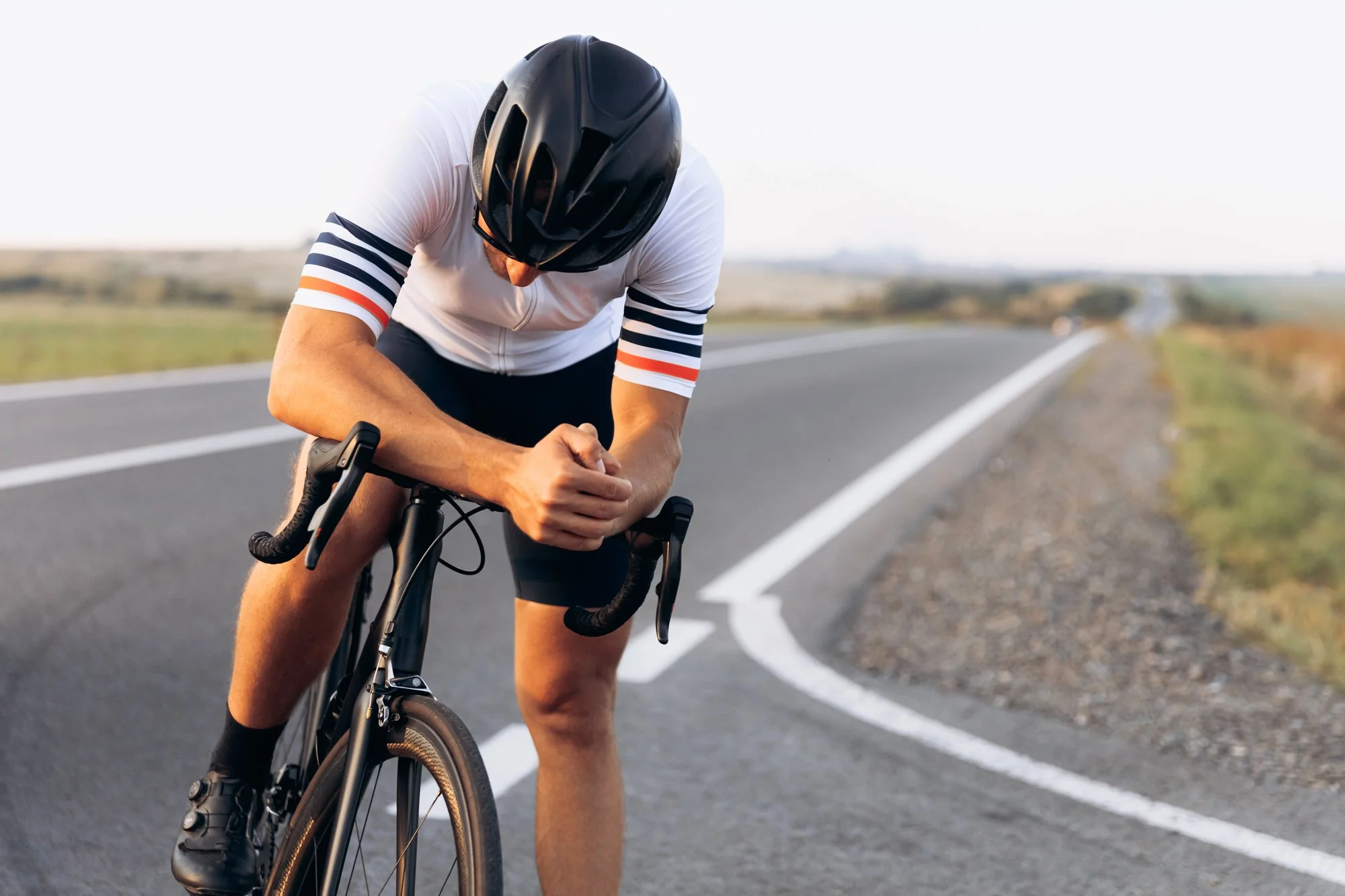
You’re 2 or 3 (or more) hours into your ride and that familiar lower back ache starts creeping in. You shift positions, stand up more frequently, try to stretch it out. But eventually, every pedal stroke reminds you something's not right. You finish the ride, but the pain lingers for days.
Sound familiar? You're not alone. Research shows over 50% of professional cyclists experience lower back pain, making it the most common overuse injury in cycling. (1)
Here's the part most cyclists miss: your bike fit might be perfect, but if your core can't do its job, your lower back will pay the price on every long ride.
Why Your Back Hurts (It's Not What You Think)
The cycling position inherently challenges your lower back. You're holding your torso in forward flexion for hours while your legs generate significant power beneath you. This creates a biomechanical demand that requires serious core stability to manage safely.
Without adequate core strength, your lower back muscles take over responsibilities they weren't designed for. Your spinal erectors work overtime trying to stabilize your pelvis and maintain your riding position. The result? Muscular fatigue, pain, and eventually chronic dysfunction.
Studies comparing cyclists with and without lower back pain reveal a consistent pattern: those with pain show altered spinal kinematics, core muscle activation imbalances, and back extensor endurance deficits. (2) Your back hurts because muscles that should be stabilizing (your deep core) aren't firing properly, forcing superficial muscles to compensate.
Think of it this way: your legs are incredibly powerful engines generating hundreds of watts. That power needs to transfer efficiently through your pelvis to your pedals. If your core can't provide a stable platform, energy leaks everywhere—and your lower back absorbs the stress of those inefficiencies.
For cyclists over 40, this problem compounds. Natural age-related changes in muscle recruitment patterns mean your core stability deteriorates faster than you realize. The core strength that worked fine for 2-hour rides in your thirties isn't sufficient for the same rides in your forties and fifties.
The Core You Need for Pain-Free Endurance
When most people think "core," they picture six-pack abs. But the core stability cycling demands is completely different from what traditional ab exercises develop.
Your cycling core needs to resist rotation and maintain neutral spine position while your legs create alternating forces. This requires anti-rotation strength, hip stability, and endurance capacity to maintain proper activation for hours, not minutes.
A study of the Swiss National cycling team found that 47.9% of athletes who intensified their core strength training over a four-month period significantly reduced their back pain during cycling, in competition, and in daily life. (3) The right core work doesn't just prevent pain; it improves your ability to maintain power output when fatigue sets in.
Why Most Core Exercises Fail Cyclists
Here's where things get interesting: crunches, sit-ups, and planks aren't enough. Those exercises develop core flexion or static holding patterns. Cycling demands something completely different—the ability to stabilize your lumbar spine and pelvis against rotational forces while maintaining hip mobility.
Professional cyclists work on dissociation: the ability to move powerfully at the hip while keeping the lumbar spine and pelvis stable. This requires specific movement control that generic core exercises simply don't develop.
Additionally, cyclists with lower back pain typically show tightness in the posterior chain—hamstrings, glutes, and hip capsule. (3) This tightness pulls you into posterior pelvic tilt, increasing flexion load on your lumbar spine. You need core strength AND mobility work to address both sides of the equation.
The Glute Connection Nobody Talks About
Your glutes aren't just for power—they're critical stabilizers that protect your lower back. Weak or poorly activated glutes force your lower back to take over hip extension work during the pedal stroke.
Research on core stability and low back pain confirms that gluteal muscles are crucial to modulate forces between lower limbs and the spine. (4) Impaired hip extensor function can cause increased pressure at the L5-S1 and sacroiliac joints, leading to functional limitations and pain.
When your glutes don't fire properly, you lose the ability to maintain neutral pelvic position. Your pelvis rocks side to side excessively, creating repetitive micro-trauma to your lower back with every pedal stroke. Multiply that by thousands of revolutions per ride, and you understand why the pain builds progressively.
Addressing gluteal activation is non-negotiable for resolving cycling-related back pain. Your glutes need to do their job so your lower back can do its job—which is stabilization, not power production.
The Weekly Training Volume Factor
Research reveals a direct correlation between weekly riding distance and lower back pain incidence. Cyclists riding 160km or more weekly are 3.6 times more likely to experience lower back pain compared to those riding less. (3)
This isn't about riding too much—it's about riding more than your current core endurance can support. Your core muscles fatigue before your cardiovascular system or leg muscles, leaving your back unprotected exactly when rides get longest and most demanding.
This creates a vicious cycle: your back hurts, so you modify your position seeking relief. Position changes create new biomechanical compensations. Those compensations create different pain patterns or overload other structures.
The solution isn't riding less. It's building the core endurance and stability that matches your riding volume and ambitions.
FAQ
How long does it take to fix lower back pain with core training? Meta-analysis of core stability studies shows significant pain reduction at 3 months, with functional improvements visible even earlier at 3-4 weeks. Lasting changes require consistent work over several months to rebuild proper movement patterns and muscular endurance.
Should I stop riding while my back hurts? Not necessarily—complete rest often isn't beneficial for non-specific lower back pain. Reduce ride duration and intensity while you build core stability. Focus on maintaining neutral spine position during shorter rides. If pain worsens during or after riding, seek professional guidance before continuing.
Are bike fit adjustments necessary if I fix my core? Possibly—many cyclists develop poor bike positions because their bodies adapted to core weakness. As your core improves, you may find you can tolerate or prefer different positions. Get professional fitting after establishing better core stability to optimize both comfort and performance.
Can I do core work on the same days I ride? Yes—core stability work doesn't require the same recovery as hard cycling efforts. Many cyclists do 10-15 minutes of specific core work after easy rides or on rest days. Avoid heavy core training immediately before hard riding efforts, as pre-fatiguing your core compromises spinal stability when you need it most.
References
Clarsen, B., Krosshaug, T., & Bahr, R. (2010). Overuse injuries in professional road cyclists. The American Journal of Sports Medicine, 38(12), 2494-2501.
Burnett, A. F., Cornelius, M. W., Dankaerts, W., & O'Sullivan, P. B. (2004). Spinal kinematics and trunk muscle activity in cyclists: A comparison between healthy controls and non-specific chronic low back pain subjects. Manual Therapy, 9(4), 211-219.
Oh, N. (2024). Lower back pain and cycling: I'm a physiotherapist, and here's all you need to know. Cycling Weekly. Retrieved from https://www.cyclingweekly.com/fitness/lower-back-pain-and-cycling
Kumar, T., Kumar, S., Nezamuddin, M., & Sharma, V. P. (2015). Efficacy of core muscle strengthening exercise in chronic low back pain patients. Journal of Back and Musculoskeletal Rehabilitation, 28(4), 699-707.