Heart Rate vs Power: Which Should You Train By?
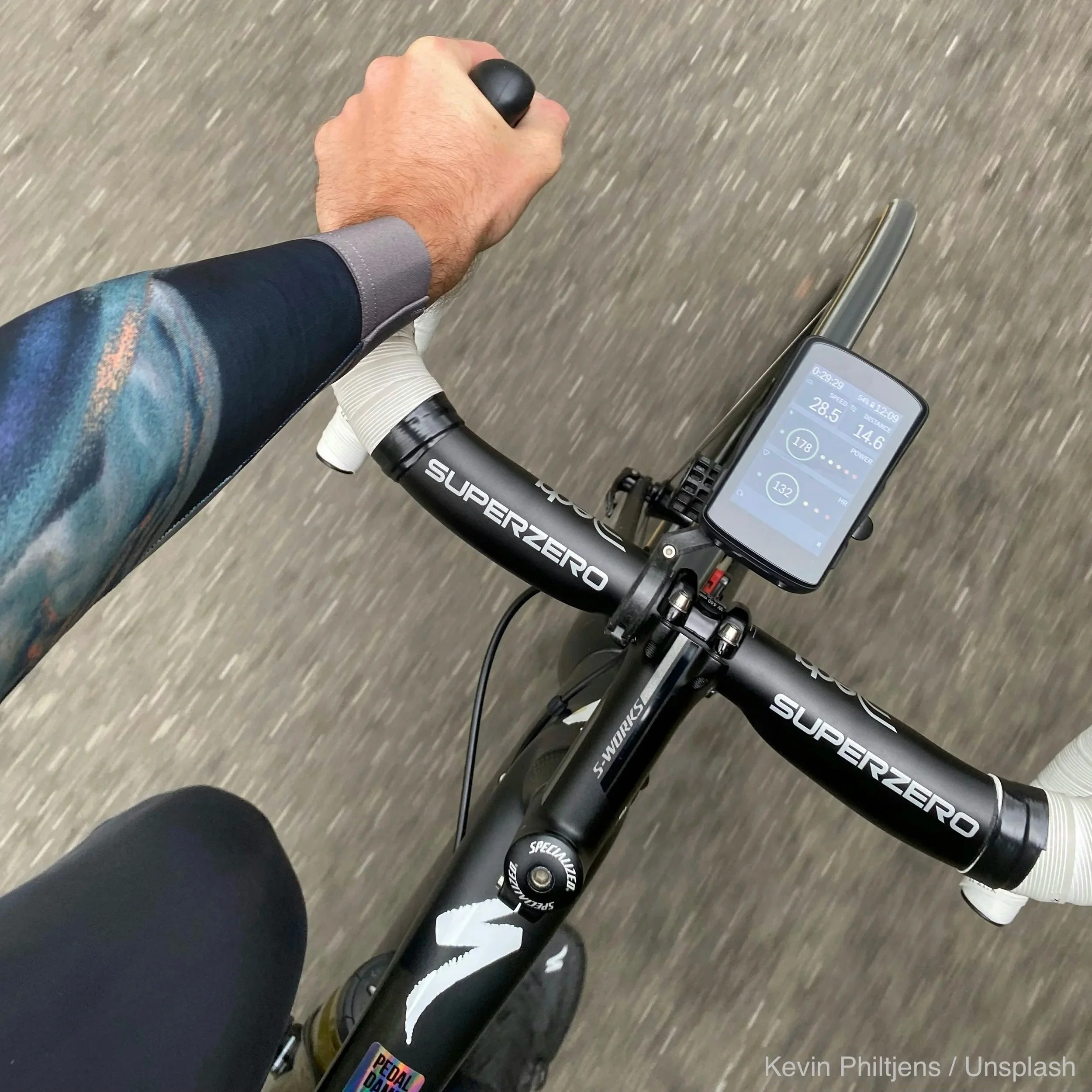
You've got a Garmin on your bars and a heart rate strap on your chest. Maybe you've been thinking about a power meter. Or maybe you already have one and you're not quite sure you're using it right.
The debate between training by heart rate and training by power is one of the most discussed topics in cycling — and one of the most misunderstood. Because the real answer isn't which one is better. It's understanding what each one actually measures, where each one lies to you, and how a masters cyclist over 40 should be using them.
What Heart Rate Actually Measures (And Where It Fails)
Heart rate measures your body's internal response to effort — how hard your cardiovascular system is working in a given moment. That makes it genuinely useful information. But understand that it is a lagging indicator.
When you accelerate hard out of a corner or surge over a crest, your heart rate takes 10, 20, 30+ seconds to catch up to the actual effort. By the time your monitor shows the peak, the surge is already over. For steady efforts over long durations, this lag is largely irrelevant. For intervals, climbs, and group ride surges, it means you're always looking in the rear-view mirror.
There's a second issue that becomes particularly significant for masters cyclists: heart rate variability. Your heart rate at a given effort isn't fixed from day to day. It fluctuates with fatigue, hydration, temperature, stress, caffeine, illness, and sleep quality. A heart rate of 155bpm might represent your threshold on Monday and a hard endurance effort on Friday after a poor night's sleep.
This variability is one of the reasons experienced coaches often describe heart rate as a measurement of how your body is responding to its circumstances — not simply how hard you're working. That information is valuable. But it means training zones established from a rested test don't reliably describe the same effort in different conditions.
What Power Actually Measures (And Where It Fails)
Power measures the external work you're doing on the bike — the watts being applied to the pedals, independent of how your body feels. One watt is always one watt, regardless of temperature, fatigue, or stress. That objectivity is power... pun intended :)
It means you can set a precise training stimulus — the same amount of work, delivered with the same physiological target, on any day of the week. It means your intervals are comparable across weeks and months, giving you a true picture of whether you're improving.
Research directly comparing heart rate-based and power-based interval training in cyclists found no superiority of either method — both produced meaningful improvements in time trial performance and lactate threshold — but noted that power provides the precision needed for consistent interval execution that heart rate alone cannot (Coons et al., 2011).
Power's limitation is equally important: it measures what you're doing, not how your body is handling it. A rider producing 250 watts when fully rested and 250 watts when exhausted is doing the same external work — but the internal cost is vastly different. Power cannot tell you whether a given effort is appropriate for the day. And this is important!
Why This Matters Differently After 40
For masters cyclists, there's an additional dimension that makes this question more important than it is for younger riders.
After 40, the relationship between perceived effort, heart rate, and actual physiological state becomes less reliable. Recovery is different. Training stress can linger longer. A power output that was appropriate on Tuesday may genuinely be too much on Thursday.
This means masters cyclists need both data streams — not to choose between them, but to interpret each in relation to the other. When power and heart rate tell different stories on the same ride, you need to manage that when its happening.
The Most Useful Way to Think About Both
Power is an external measure. Heart rate is an internal measure. Neither is complete without the other.
The relationship between them — how much internal cost your body is paying to produce a given external output — is one of the most meaningful indicators of fitness and recovery available to a cyclist. When that relationship shifts, something important has changed: you're either fitter, more fatigued, under-recovered, or heading toward illness.
Masters cyclists who learn to read the relationship between power and heart rate across their training — rather than chasing a number from either metric in isolation — develop a sophistication about their own physiology that no single device can provide. They know when to push, when to pull back, and when the data is telling them something their legs haven't admitted yet.
That's not something a power meter gives you. It's something you build over time, by paying attention to both.
And the best bit... you can still be improving overt time, even when the data looks like you might not be in that moment.
Frequently Asked Questions
I only have a heart rate monitor. Is that enough?
Yes — heart rate training produces real performance improvements when applied consistently and intelligently. Research confirms this. The limitation is precision for short interval work, where heart rate lag makes it difficult to execute brief high-intensity efforts accurately.
Do I need a power meter to train effectively?
Not necessarily, but it changes what's possible. Power meters remove the ambiguity from effort control, enable consistent interval execution, and allow direct comparison of fitness over time. In short, it makes it all easier. Whether that is worth the investment depend on how you want to approach your training and riding.
What about RPE — perceived effort — as a third tool?
RPE is underrated. Research shows that experienced athletes can estimate physiological intensity through perceived effort with surprising accuracy. Used alongside heart rate and/or power, it adds a qualitative layer that neither device captures. RPE is powerful and means you are really tuned into your body.
My heart rate seems lower than usual at the same power. What does that mean?
Typically, it means one of three things: you're fitter, you're more recovered than usual, or there's a measurement issue. A sustained and consistent shift in the power-to-heart-rate relationship — over multiple rides — is generally a reliable indicator of improving fitness.
References
Coons, J. M., Bowman, T. A., Arnett, S. W., Dobridge, J. L., & Farrar, R. P. (2011). Effects of high intensity training by heart rate or power in recreational cyclists. Journal of Human Sport and Exercise, 6(3), 563–573. https://pmc.ncbi.nlm.nih.gov/articles/PMC3737823/
Seiler, S. (2010). What is best practice for training intensity and duration distribution in endurance athletes? International Journal of Sports Physiology and Performance, 5(3), 276–291. https://doi.org/10.1123/ijspp.5.3.276
Zapico, A. G., Calderón, F. J., Benito, P. J., González, C., Parisi, A., Pigozzi, F., & Di Salvo, V. (2007). Evolution of physiological and haematological parameters with training load in elite male road cyclists: A longitudinal study. Journal of Sports Medicine and Physical Fitness, 47(2), 191–196.