Hydration In The Heat: Why Thirst Alone Won't Cut It
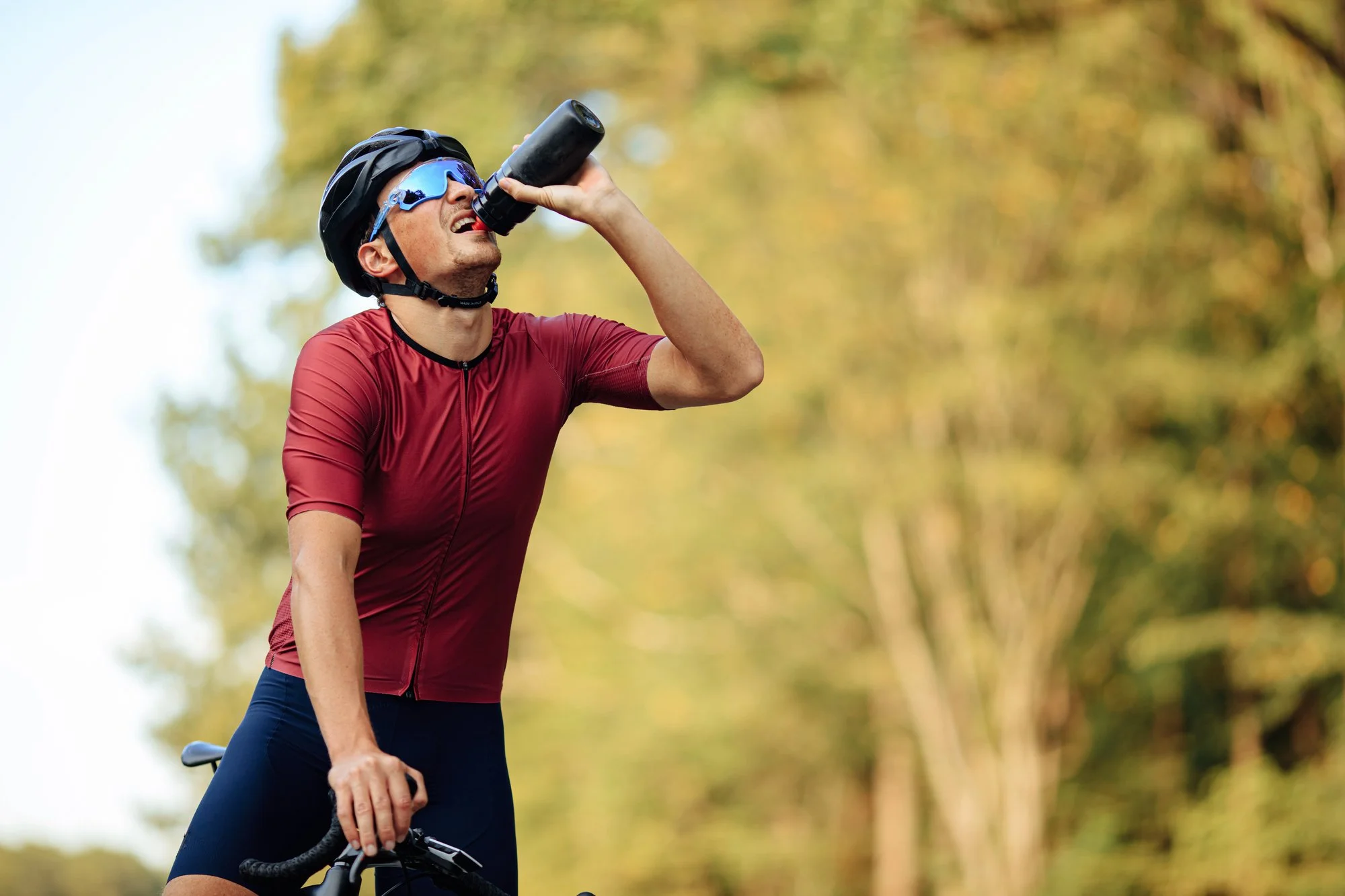
Many cyclists treat hydration as a simplest part of the sport. Get thirsty, drink, done… they've ridden that way for years, so why would anything need to change now?
But thirst is a signal. And like most signals the body sends, it doesn't stay the same over time.
What thirst actually is
Thirst gets triggered by two things — a rise in the concentration of the blood (osmolality), and a drop in blood volume. Sensors throughout your body pick both up and tell the brain to go find a drink.
As you get older, that system gets less responsive. The "set point" (hydration level) drifts, so your body will sit in a slightly more dehydrated state before thirst signalling is triggered.
Then add bike riding and warm weather. You sweat more, losing fluid faster. And you have a slower responding thirst mechanism... what can go wrong?
Three things stacking up
Now there is also another thing going on under the surface. Muscle holds a big share of your body's water, and over the age of 40 we slowly lose muscle size and bulk - unless we work to hold onto it.
Less muscle means a smaller reservoir of water to draw on. So the same amount of sweat can dehydrate you more and quicker than when you were younger.
It doesn't take much of a drop to matter. A fluid loss of just 1-2% of body weight is enough to significantly reduce your endurance capacity, take the edge off harder efforts, and make your whole ride feel like more work than it should.
So on a hot day, three things can work against you all at once — your thirst signal arrives late, your hydration reservoir is smaller, and it takes a smaller deficit to make a big difference.
And this increases as you get older... A small lag in performance in your 40s is a bigger one in your 50s and bigger still beyond 60.
Put all this together and these are more likely the reasons why you get dropped, and why your performance drops off, unable to keep the power and speed up, in the last third or so of a hot ride. It's not a sudden loss of fitness.
So what do you do about it?
It starts with a shift in thinking first. On a warm day, stop riding to thirst. In the heat, thirst lags behind what's actually happening in the body... in short, it's a late and completely unreliable signal.
You need to start riding to a plan.
A few simple pointers to see you right:
- Drink early and on a timed rhythm. Even when you don'f necessarily feel like it. Remember, thirst is an unreliable marker
- Start properly topped up and hydrated. This means you're not starting out already having to catch up.
- Get a rough sense of how much you actually lose on a warm ride. Most cyclists have never once checked. A simple way is to weight yourself before and after a ride, also keeping a note of what how much you drunk and roughly how much you lost at 'nature breaks'.
- Don't forget salt replacement. Sweating means losing salt. And lots of sweating on hot days means more salt is lost.
And then there's the finer details:
- How much to drink?
- How often?
- What goes in your bottle?
- How to plan for longer and harder rides on hot days?
All these things are important to understand and get right if you want to perform well no matter the heat.
The payoff
None of this is about forcing down litres for the sake of it. It's about matching what goes in to what the body genuinely needs on a warm or hot day, so you can perform well and finish your ride fast, strong and with plenty in the tank.
Get this right and it's among the easiest wins in masters cycling. No extra training hours, no more suffering... but maximising your training gains and performances.
Frequently Asked Questions
Do I really need to drink more just because it's warm?
Short answer, yes… the warmer it is, the more you sweat, and the faster fluid leaves you. The catch is that the signal telling you to top up gets less reliable over the years, so on a hot day it pays to have a plan rather than wait to feel it.
Should I drink to a schedule instead of to thirst?
On a warm ride, a rough rhythm beats waiting for thirst, because thirst tends to turn up after the loss has already started. How much and how often is individual… it shifts with the rider, the heat and the length of the day.
Is plain water enough, or do I need electrolytes in the bottle?
Depends on the day. For a short, cool spin, water's usually fine. Once it's hot and the ride stretches out and you're sweating hard for a few hours, what's in the bottle starts to matter a lot more.
Can I just make up for it by drinking loads afterwards?
You can rehydrate afterwards, but you can't undo what a big deficit did to the ride while it was happening… and the body's a touch slower to restore balance as the years go on. Far better to stay on top of it as you go.
References
1. Kenney, W. L., & Chiu, P. (2001). Influence of age on thirst and fluid intake. Medicine & Science in Sports & Exercise, 33(9), 1524–1532. https://doi.org/10.1097/00005768-200109000-00016
2. Sawka, M. N., Burke, L. M., Eichner, E. R., Maughan, R. J., Montain, S. J., & Stachenfeld, N. S. (2007). American College of Sports Medicine position stand. Exercise and fluid replacement. Medicine & Science in Sports & Exercise, 39(2), 377–390. https://doi.org/10.1249/mss.0b013e31802ca597
3. Cheuvront, S. N., & Kenefick, R. W. (2014). Dehydration: physiology, assessment, and performance effects. Comprehensive Physiology, 4(1), 257–285. https://doi.org/10.1002/cphy.c130017